All too many articles about rifle scopes are “techno-porn;” that is, they discuss the merits of optics that start at $2000 and which they know very well are beyond the means of the demographic they are selling their magazine to. The reason people mount a tactical scope on a deer rifle and even consider risking their lives by aiming it at professional infantry soldiers is because they are desperate. Thanks to corrupt politicians who have bankrupted their government, driven their economy into the ground and left the people freezing for lack of heating fuel, they feel that they have no other recourse than to take up arms against the communists.
In this article I will compare three rifles scopes, all of which I own and have tested on a high-power rifle. All three list for less than $400, a sum that most people can come up with; if you shop around, you can find them for about 10% less. The chart below displays their technical specifications. The minimum needed to qualify as a tactical scope is finger-adjustable elevation and windage dials and a reticule that measures mils. The $1750 Leupold is not being reviewed but is shown for comparison. It’s features are essentially the same as the Bushnell but it has better glass than all three of the scopes being reviewed, which is why it costs over four times as much. The quality of the glass is not exaggerated. I have used a military-issue Mark IV and the image is surprisingly clear; one can shoot for another fifteen minutes at dusk and, in the daytime, one can see bullet holes in paper targets that are invisible to lesser scopes. But the reality is that snipers are expendable in the same way that fighter pilots once were. After Pearl Harbor, we put everybody who volunteered for it through a month of pilot training and sent them to face Japanese pilots with years of stick time over China and Korea. The good ones became aces and the weak one cost the government a Corsair, which were rolling off Detroit assembly lines faster than Chevrolets ever did. Similarly, if the Red Army is massing on your eastern border, you are not going to win that fight by putting a $4000 rifle and an $1800 scope in the hands of the national 1000-meter bull’s eye champion while ignoring the other 45 million citizens who volunteered. For the price of a single T-84, the government could give every citizen who qualifies (pass a background check and verify that one is not a criminal or a communist) a $600 rifle and a $400 tactical scope. Housewives and file clerks will be picking off Green Men from every apartment and office window! If you just want the lowdown on these scopes, scroll to the end of the review and you will find the same chart with stars (one to five) denoting how well each scope performs in each category and a brief summary of their overall performance.
I have listed the characteristics in order of their importance to the sniper. Dial Reliability This characteristic gets top priority because, if the dials fail, then none of the other characteristics matter. Reliability is at least partly related to the click increment. The first BSA that I purchased I had to send back because, after wasting several boxes of expensive ammunition trying to zero my rifle, I realized that the dials were moving under recoil. I did not have this problem with the replacement they sent me, but I am convinced that the eighth MOA clicks are too fine. Besides being an annoyance because it takes too much dialing to set four or five MOA, which is a fairly typical windage adjustment, the tiny gear teeth are probably the cause of this slippage. Another problem with the BSA dials is that the three tiny sets screws that hold them in place after one has zeroed the rifle and set it to read “zero” for no wind are too small. After a long day of dialing the windage dial back and forth between every shot, the dial starts to feel squishy and has slipped a few clicks. Leupold’s “target turrets” have the same problem as BSA and are actually worse because they are too big for the rifle to fit easily in its case and they tend to snag on things. The windage dial is so big that I have to press the rifle case cover down to latch it, which means that the target turret is pressed against the hard plastic case and thus vulnerable to damage. These are not the same turrets that the Mark IV has; these are the turrets that come with target scopes and are available to hunters as a rather expensive customization. But not only are they expensive, they are also no good; too big and too fragile. I have a Vari-X III Leupold on my .22RF rifle that I use in silhouette competition and I once lost a match because I stepped up to the shooting line, turned my dial a little too enthusiastically, and it came loose. If that happened in combat, my rifle would be rendered useless. Dismayed by the price of their Mark IV, I tried to turn a Vari-X II into a tactical scope by having their custom shop install a mil-dot reticule and target turrets, doubling its price to nearly $600 and well over our $400 limit. Big waste of money! I fired it side-by-side with a military-issue Mark IV and the image quality was not even close; just because they are made by the same company does not mean they have comparable glass. Hunting-grade Leupold scopes have image quality that is no better than any of the scopes being reviewed here. If Leupold were being reviewed, I would give them and their target turrets one star. I am giving BSA two stars because their dials are smaller and somewhat better than Leupold’s target turrets, though they use the same three-tiny-set-screws technology. I am giving four stars to Bushnell and five to Hawke because the Hawke dials have the added feature of being lockable, so one does not accidentally turn them. Both Bushnell and Hawke look and feel very durable; I have not had any problems with either and do not expect that I will. Reticule Brief historical note: Cross hairs are called that because, at one time, they really were strands of hair stretched across the interior of the scope housing. During the Vietnam War, Unertl invented the mil-dot scope and achieved this by meticulously putting drops of solder on the wires that had by then replaced the hairs. Today, scope manufacturers have the ability to etch any image they want in the glass. The reason that even expensive scopes have dots is just tradition; large dashes for whole mils and small dashes for half mils actually work better. This is how the Germans do it; but who can afford German glass? Indeed, I use the term “mil-dot reticule” throughout this website, but that is not because I favor dots over dashes. It is just the traditional term for any scope that measures mils. One can make more precise measurements with dashes than with dots. However, dashes are the only worthwhile innovation to appear since Unertl’s groundbreaking work. I have seen scopes with grids of lines etched into the glass. This is what scientific microscopes look like. But the important difference is that nobody is shooting at the scientist. In the quiet of his laboratory, the scientist can get used to such a complicated reticule. In combat, KISS (Keep It Simple, Stupid) is always good advice. The basic design developed by Unertl and employed by all three of these manufacturers is really the best one for snipers. Illumination of the reticule is very important. You do not need night vision equipment to fight at night, but you do need an illuminated reticule. Indeed, if the moon is mostly full or there are city lights nearby or flares floating down on parachutes, an illuminated reticule on a glass scope actually works better than peering at the green glow of a night vision scope. I did an experiment once where I had a friend walk towards me through desert scrub brush on a moonlit night. Under these conditions, with any scope – including a $60 no-name scope with no lens coating – I could spot him at about 80 to 90 meters. I did not have a Mark IV available for this test and it might have added a few meters but, the fact is, the most important point is just to have a scope. With my naked eye, I typically did not spot him until he was within 10 to 15 meters. With an illuminated reticule, I could have hit him as soon as I saw him, around 80 to 90 meters. Without the illuminated reticule, trying to shoot him would have been a shot in the dark – literally – and would have probably missed until he was within 10 to 15 meters. So, basically, optics are very useful for spotting people in the dark but, without an illuminated reticule, they are no better than iron sights for shooting them. Incidentally, I learned something else from this experiment: The first clearly recognizable human characteristic to come into view is the person’s two legs. There is nothing that looks as distinctly human as two vertical legs side-by-side. Expensive camouflage clothing with screen prints of tree leaves is not necessary and will draw attention in the city. Wear fashionable but dark clothing and – most important – tie your jacket around your waist to break up the silhouette of your legs. If it is too cold to take off your jacket, you might consider a cape. This is actually practical because, if it is waterproof, you can lie on it without getting your clothes wet. As long as you do not also have an “S” printed on your chest, wearing a cape won’t look funny in the least. Bushnell has dots and no illumination; it gets one star. BSA has dots and red illumination and gets three stars. Hawke has dots and half tics and a choice of red or green illumination. The Aguilar System for Medium-Range Sniping often calls for holding on half-mils and the little tics between the dots on the Hawke make this easier. Also, the option of green illumination is very useful when one’s city is on fire, as shown in the image of Independence Square in Kyiv, Ukraine. Five stars for Hawke! 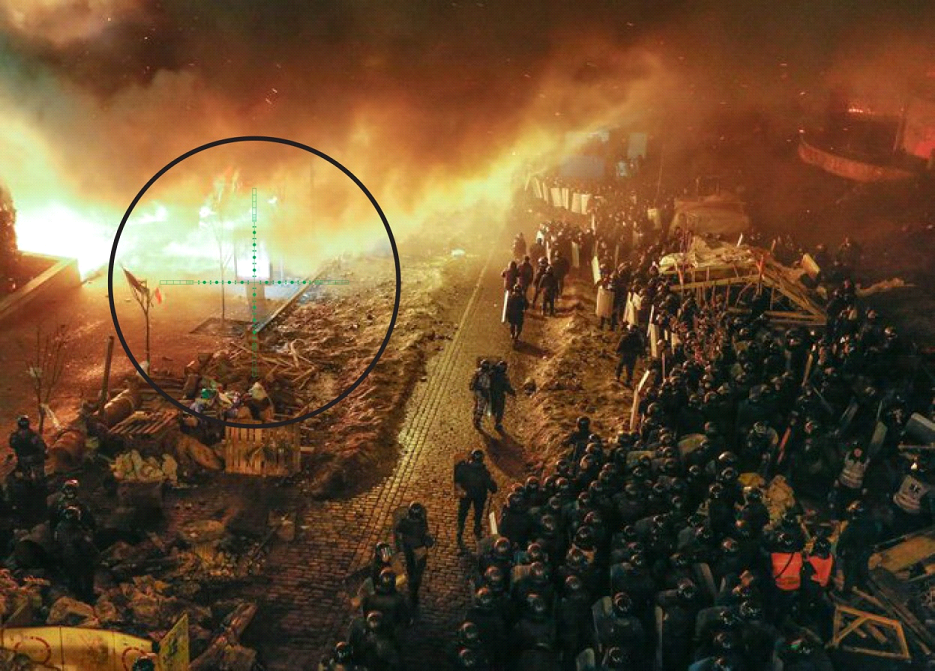
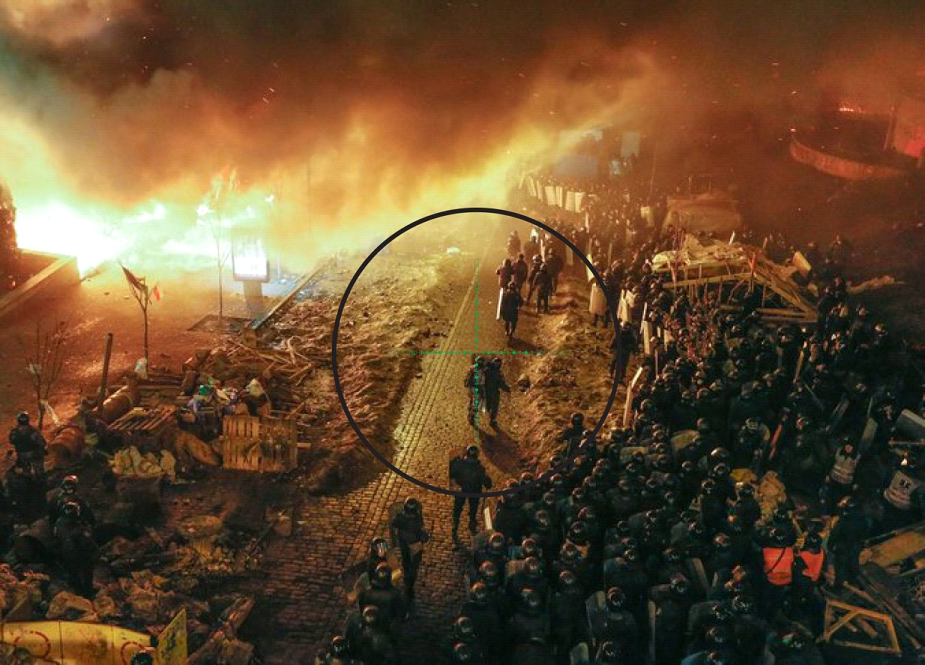
Observe the lightbox in the first photo; it subtends four mil of angle. Anybody who has read my instruction page would have memorized the following chart and immediately known to range off the frame of the box. Translucent signs with internal illumination are ubiquitous in Ukrainian cities and they are all the same size; 76” high, not including the base.
A BTR-80 is 76” from the grounds to the top of the hull. A Ural truck is 76” from the running board to the top of the cab. A Tiger truck is 76” from the bottom of the hull to the top of the roof. A Kamaz truck is 76” from the bottom of the bumper to the top of the roof and also from the bottom of the tailgate to the top of the canopy. Note that the adjustment for a 10 mph wind in minutes-of-angle is two more than the holdover in milliradians (mils). Observe the military officer in camouflage. Without ever taking one’s eyes off the scope, those studied in the flashcard system know: Hold on the second mil-dot to shoot the Russian officer, as shown in the second photo. Gotcha! On this page I illustrate ranging off a burning BTR-80 and use the un-illuminated reticule on the 10X Mark IV, which is almost invisible in the photograph. The variable power Leupold scopes are available with an illuminated red reticule, but that is no better than the un-illuminated 10X Mark IV against a background of flames. Of course, if the flames are too bright, then it will hurt your eyes to look at them through magnified optics – another reason why the 16X BSA is a bad idea – and you will not be able to make the shot. Wood fires are not too bad but white phosphorous (WP) and, even more so, magnesium, are blindingly bright. The Russians typically prep a city with WP artillery shells that burst in the air; a couple hours later when they send in their ground troops, the brilliant WP fires will have burned away, leaving the houses with shingle roofs and the upper floors of all the apartment and office buildings still burning with the orange flames that are familiar to anyone with a wood stove. The whole city will glow red like a scene from Dante’s Inferno. If you have a green reticule on your rifle scope, you can be there to greet the Russian soldiers as they enter your city.
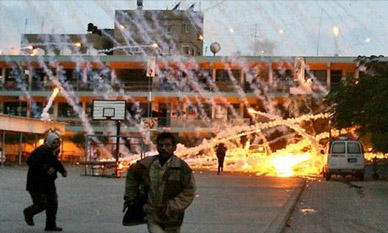
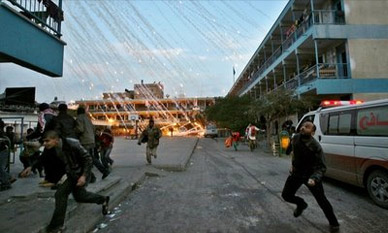
This is actually the Israelis shelling the Palestinians with American artillery, but the Russians have similar weapons. The also have Shmel thermobaric weapons, which are man portable. Field Of View If you cannot find the enemy, you cannot shoot him. (But don’t worry; if you wait a few minutes, he’ll find you.) Rubble all looks the same and, if you have to put your rifle down while you calculate holdover and windage, there is a very real possibility that you will not be able to find your target again. Field of view is inversely related to magnification. I and most snipers feel that 10X is a good compromise, one that provides adequate magnification and adequate field of view. The reason that the BSA has only a 2.5 m field of view is because it is 16X; it has a wider field of view at lower powers. After finding a target on low power, one could try holding the rifle steady with one hand while dialing the power dial back up to 16X with the other hand before firing. But that would be ridiculous. There is no way one could hold the rifle steady with one hand while turning the power dial with the other, and such gymnastics will probably be spotted by the enemy. BSA operators will certainly just leave their scope at 16X and struggle with having too small a field of view. The variable power is not doing them any good. If the operator of a BSA – or any variable power scope – accidentally fired with their scope on a low power, they would hit the dirt well in front of their target because their mil-dots are only accurate at the highest magnification. The reader may believe that a highly trained professional such as himself would never do such a thing, but I tell you: it happens. KISS (Keep It Simple, Stupid) is good advice for even the most highly trained. At a time when I was excelling at 500-yard tactical matches (I had my rifle zeroed at 300 yards and held on the second mil-dot), I asked my girlfriend to pull targets for me in practice, secretly hoping that she would be amazed and impressed when she saw me hit the 10-ring again and again. Instead, I fired shot after shot in the dirt. Oops!!! If I had not been stressed out by her presence, I might have noticed that the target seemed smaller than usual. I had my scope on 3X, not 9X. Also, the variable power adds length and weight to a scope, as well as more moving lenses that might eventually come loose. There is really no good reason to have this feature in a tactical scope. Variable power is useful to hunters because they are not using the reticule to calculate holdover and windage – they just put the crosshairs directly on the target – and they may want low power for some hunts and high power for others. But variable power is not for snipers. In this category, I am giving BSA one star because of their tiny 2.5 m field of view. Bushnell and Hawke have the same magnification but Hawke’s 3.9 m is slightly more than Bushnell’s 3.5 m, so I am giving Hawke five stars and Bushnell four stars. Eye Relief I once purchased an IOR Bucharesti tactical scope for $500 and it whacked me in the eye every time I fired it. Also, it was out of focus and it did not return to zero. The worst optics purchase I ever made! This is an extreme case and the 89 mm of the BSA and Bushnell is actually sufficient. But the 102 mm of the Hawke is better. It helps one make quick follow-up shots with a powerful rifle because one can more quickly find the target and get the image centered again. The extra 13 mm helps a little in keeping one’s breath from fogging up the objective if one is breathing hard from exertion. The Russians had a good idea with that accordion-like rubber device around the ocular lens of their Dragunov scope. It protects the lens from scratches without the extra hand movement required of American snipers to flip up their scope cover, and the Dragunov is also protected against getting fogged up if one is breathing heavily. Perhaps one of the three manufacturers reviewed here could devise a similar device for their tactical scope. (But I do NOT recommend the Dragunov reticule, which is useless.) Leupold has written of a “triangle” between magnification, field of view and eye relief; they state that one cannot increase one characteristic without adversely affecting the others. Observe that the ET 1040 and the Mark IV have the same magnification but the ET 1040 is slightly better in eye relief and slightly worse in field of view. This is in line with Leupold’s dictum that it is impossible for a scope of the same magnification to excel at both. So it may seem surprising that the HK 4034 has the same magnification but is beating the ET 1040 and the Mark IV in both field of view and eye relief. But this is because the HK 4034 has a 42 mm objective lens while the others have 40 mm objectives. So why not have a 50 mm objective? Would this not improve all of these statistics? A 50 mm objective lens requires high mounts, but sniper rifles are fired from the prone position where keeping the scope as low as possible is necessary. Indeed, my HK 4034 came with medium – not low – mounts, though the extra two millimeters do not bother me. I do not own a scope with a 50 mm objective and have not fired such a rifle prone, but many people who have complain bitterly that it hurts their neck to tilt their head up so much. Such awkward positions are why people think they need an adjustable objective; if their prone position is comfortable, then they have a consistent check-weld and parallax is not a problem at sniper ranges; that is, beyond 200 meters. Hunting rifles are always fired from the standing position and so should have 50 mm scopes mounted high. Most hunters do not understand this because their “practice” consists of firing off a concrete bench. Later, they are genuinely surprised when they spot a deer while walking around upright – crawling is only needed if someone is shooting at you – and suddenly remember the airline’s unreasonable refusal to allow their concrete bench as carry-on luggage. A quick aside on the subject of rifle design: There are two basic kinds of military rifles; sniper and assault. Sniper rifles are always fired from the prone position and thus have the scope mounted as low as possible, which requires a small 40 or 42 mm objective lens. Assault rifles are always fired from the standing position and thus require the sights to be mounted high so a straight stock can recoil directly into the shooter’s shoulder. The AR-15 is a good example; the open sights are mounted on top of the carrying handle and the front sight is on a high post, or one can dispense with the carrying handle and mount a large red dot scope that brings the line of sight up to the same height. Hunting rifles are a hybrid; they are almost always fired from the standing position, like assault rifles, but are bolt-action and of the same caliber as sniper rifles. They require variable power scopes of 2–7X or 3–9X; not fixed 10X as is accepted in the sniper community. Because hunters fire from the standing position, they want their scopes mounted high with 50 mm objective lenses and illuminated duplex – not mil-dot – reticules. They should be zeroed at 200 yards and never fired past their point-blank range, 230 to 250 yards, unlike sniper rifles that are zeroed at 300 yards (300 meters for the 7.62 NATO) and dialed in for longer shots. Note. Nineteenth century rifle makers did not have glass or red dot scopes and apparently did not have the ability or the wit to make a carrying handle and high front post like the M16, so they had a curved stock to bring the sights up to the shooter’s eye when in the standing position. This resulted in excessive muzzle rise; in spite of our fascination with the Old West, we must admit that their rifles were no good. This lesson is not well understood even today. Excessive muzzle rise due to its curved stock was the cause of the M14’s early demise. My experience with the M249 squad automatic weapon is that it has excessive muzzle rise; it works best with a full 200-round box of ammunition. Because the fore-end has a shallow finger groove in slick plastic, it is difficult to grip when one’s hands are sweaty. I would put a strap around it so I could pull downward on the strap to keep the bipod from lifting off the ground. The WWII German MG 42 was more powerful and fired faster but had less muzzle rise; it should be our model for squad automatic weapons. Regarding eye relief, the Hawke gets five stars. Bushnell and BSA get four stars. If IOR were being reviewed here, it would get one star. Every sniper who has read the history of his profession has learned of famous snipers who got shot because their enemy saw light reflecting off their objective lens. I am not sure how often this actually happens, but there are snipers who will refuse to use a scope if it does not come with a sunshade.
On a somewhat more practical note, having to flip up a scope cover is an extra movement that takes time and might be spotted by the enemy. A sunshade protects the objective lens from scratches and does not have to be flipped up, so that is a good thing. If the enemy is searching for you with powerful optics, you do not want to be moving your hands around too much. This is also why it is a good idea not to fire with the muzzle over water, because of the ripples, or over powdery material like snow or dust. Note. The Hawke comes with a 100 mm sunshade, as does the BSA (the one I purchased years ago did not, but their website now lists this as included) and so they both get five stars. My Bushnell did not come with a sunshade and I looked under “accessories” on their website and did not see one, so I do not think it is available. I will give them two stars because it is possible that generic sunshades will fit any 40 mm objective, though I have not tried this. Tube Diameter The Aguilar System for Medium-Range Sniping is all about shooting at medium ranges, as the name suggests. Many people are also interested in shooting at long ranges and a tiny percentage of them actually have the capability of doing so. Necessary but not sufficient is the ability to dial in one’s scope for large quantities of elevation and windage. An important point that few people are aware of is that the amount of elevation and windage adjustments one can make are not independent. Because scopes are circular, not square, if you dial in a lot of elevation for a long shot, this reduces the amount of windage adjustment available to you. The reason that people are not aware of this is because all manufacturers (including the three reviewed here) simply state their range of elevation and windage adjustment on separate lines on their spec sheet, which makes them all seem to have plenty. Thus, most people give no heed to this specification. In fact, if you are going to make shots beyond 600 meters, you need a 30 mm tube. It is not possible to dial in that much elevation and windage simultaneously with a 25.4 mm tube. There is just not enough room in that little tube to move the cross hairs around so much. The Hawke has a 30 mm tube and so it gets five stars. Bushnell and BSA get two stars –I don’t want to totally slam them with one star because there are really not very many people reading this who have reason to care about shots beyond 600 meters. Adjustable Objective The Bushnell does not have an adjustable objective; it is parallax free at 150 yards but at other ranges the cross hairs move slightly when one moves one’s head from side to side. This is not a problem for shooters with a consistent cheek weld and it is far more pronounced at close ranges than long ones. Since 150 yards is as close as you want to get to soldiers armed with RPG-7 grenade launchers or light machine guns, the adjustable objective is not needed. But the Hawke 4034 is in their Sidewinder line, which means that it has an adjustable objective with an oversize dial to facilitate very precise tuning for distances as close as 10 yards. Fortunately, the big dial can be removed so it does not snag on things, but what is this feature for? Air gun field target competitors estimate range by tuning their parallax adjustment until blades of grass are in focus even while moving one’s head from side to side. This technique works only at very close ranges; the following chart gives the angle that the dial must be turned and thus how much accuracy one can expect:
At very close range, a field air gun competitor can estimate range to the nearest yard; that is, he can identify 10, 11, 12, 13, 14 and 15 yards. At close range, he can estimate range to the nearest five yards; that is, he can identify 15, 20, 25 and 30 yards. But from 30 to 50 yards, the competito’s elevation chart might as well be in ten yard increments (30, 40 and 50 yards) because he cannot expect this technique to yield more accuracy. Indeed, only the experts can hit anything with an air gun beyond 30 yards and, if their chart is in five-yard increments, then they have learned to triangulate with their eyes to that precision. The only competition available to .22 rimfire shooters is metallic silhouettes, which are at fixed ranges of 40, 60, 77 and 100 meters, so range finding is not needed. Would small game hunters need this feature? No. A .22 rimfire at 1200 fps (hunting ammunition) that is zeroed at 50 yards rises through the line of sight at 25 yards and never goes higher than a quarter inch above the line of sight. Thus, no elevation adjustment is necessary from 25 to 50 yards. How well does this technique work for long shots from 50 to 100 yards? It does not. Since its accuracy is only to the nearest 50 yards, any estimate that you make by triangulating with your eyes is a better estimate than you could make with this technique. I explain the correct way to make long shots on rabbits here. Police snipers typically fire at 50 to 100 yards – outside of handgun range – but they too would be better off triangulating with their eyes than using this technique. However, a glass scope on an AR-15 must be mounted high above the bore, so this technique has some use for shots from 10 to 50 yards because the bullet is rising at a steep angle relative to the line of sight. But this website is about military sniping. Shots from 10 to 50 yards with an AR-15, especially those fired straight down from a roof top (50 yards is an 11-story commercial building), are euphemistically described as “hostage situations.“ But in practice the only snipers actually doing this are working for Bashar al Assad and I do not want to have anything to do with him. The adjustable objective would never be used by military snipers for shooting at soldiers who can defend themselves; it is for shooting unarmed demonstrators in the town square through the tops of their heads. This is immoral and Hawke should remove the adjustable objective from their HK 4034 to avoid associating themselves with murderers. Also, an adjustable objective introduces an error of up to 3.5 MOA. I tested my Hawke with a device that allows me to see the cross hairs move as I turn dials. I verified that adjustments to the elevation and windage dials can be undone and the scope returns to zero. This is good; but I also turned the parallax adjustment and saw the cross hairs move a full 3.5 MOA up and down. This is bad; at 600 yards a 3.5 MOA error is the size of a person’s torso and would be a complete miss. Of course, there is a simple solution: Just set the scope to be parallax free at 350 yards and then Superglue the dial so it does not move. The gross 3.5 MOA error would occur only if you somehow dialed the parallax adjustment down to 10 yards and there is no reason that you would ever want to do so on a tactical scope. My BSA was not available when I conducted this test, so I do not know how much error its adjustable objective introduces but, because it is on the bell, there is less chance of it being moved accidentally. The Hawke dial is right behind the dial for adjusting the brightness of the illuminated reticule and it could easily get moved by accident. Another important point is that the Hawke is much wider than the Bushnell that I previously had on this rifle and closing its hard rifle case now requires squeezing it shut. Thus, the foam is compressed to the point that it is not protecting the scope in the event that the case receive a blow from the side. Hawke really needs to get rid of that adjustable objective so their scopes will be protected when rifles are transported in cases. Bushnell gets five stars for wisely omitting the adjustable objective. Hawke and BSA get two stars for an unneeded feature that introduces potential error; because there is an easy fix, I do not want to slam them with one star. However, if you are a field air gun competitor and are reading this review, I must warn you: Do not buy a Hawke, even the high magnification Sidewinder scopes that are specifically intended for competition. You will never succeed in hitting those little thumbnail-sized targets with 3.5 MOA error in your scope. BSA is a less expensive scope, so I doubt that it is much better than the Hawke in this regard. I also tested a Leupold Vari-X III that is not being reviewed here and it had only 0.75 MOA error, which is acceptable for field air gun competition. Packaging Nothing swells my chest with the pride of ownership like opening a hard plastic case to find expensive optics nestled in custom-made foam padding! On a practical note, these things are being air-dropped in to militia fighters behind enemy lines. Also, soldiers have about as much concern for cargo as that famous gorilla who loads our luggage at the airport. So the fact that Hawke has gone the extra mile to deliver their optics in hard plastic cases with custom-made foam padding may be the difference between owning a tactical scope and owning a box of broken glass. The cardboard boxes that Bushnell and BSA scopes come in are not totally inadequate, so I will give them both two stars. Five stars for Hawke!
To get the weighted average, I multiplied dial reliability by eight, reticule by seven, field of view by six, and so on. This is because the characteristics are listed in order of their importance to the sniper. Remember, the weighted average does not include the quality of the glass, which is why the Leupold Mark IV is not being reviewed here. This is a subjective matter, both in accessing image quality and in assigning importance to additional clarity. Personally, I see no significant difference between the Hawke, the Bushnell and the BSA in the quality of their glass and, while the Leupold Mark IV has more clarity, I do not assign it four times the value of the others. Historical Summary In 2005, when I founded Sniper Flash Cards and first took a professional interest in tactical scopes, the only scopes that I had were my BSA Mil-Dot IR, the Leupold Vari-X II that I had had their custom shop add a mil-dot reticule and target turrets to, the Vari-X III that I used (and still use) for .22RF silhouette matches, and the IOR Bucharesti that I – Thank God! – have since managed to sell for most of the $500 I paid for it. At that time I gave BSA higher marks than Leupold, which earned me the lasting enmity of a lot of Leupold fans. But those were former military men who were thinking of their beloved Mark IV. I maintain to this day that trying to turn a hunting-grade Leupold into a tactical scope is not a good idea. This is an expensive project and the result is not even equal to the lowly BSA. In 2011, I switched my allegiance to the Bushnell ET 1040, which was about $220. Its dials are considerably more durable than BSA and it has a wider field of view, but it lacks an illuminated reticule. This is a real problem. In spite of the more durable dials and the wider field of view, I hesitated to take the BSA off my rifle because it meant losing the ability to shoot at night. BSA responded by lowering their price to $160 list. Besides adding a sunshade, they did make any improvements, but chose to compete with Bushnell on price alone. For a long time, the Bushnell was not available and my customers were asking me if I could recommend something else. Then the Bushnell became available again but at a considerably higher price, $391. In the meantime, I had found the Hawke HK 4034 for about the same price that the Bushnell is now selling for. It appears every bit as durable as the Bushnell, has a slightly better field of view and eye relief and, best of all, it has an illuminated reticule. And not just that, but the reticule has half-mil tics and you get both red and green! What’s not to love? So I am definitely recommending the Hawke HK 4034 now! For people who feel that they can only afford the $160 BSA, I would recommend the Hawke HK 5162. At $240 it is more than the BSA but considerably better. The mil-dot reticule is only accurate at 10X and so I would recommend that one tape it down and use the scope as a fixed 10X. The dials are much smaller, though they can still be turned with one's fingers, unlike some competitors that have a slot for a nickel. Unlike the HK 4034, the dials are not waterproof and so the rifle should be transported with the covers on the dials. Basically, you save $160 and get dials that are functional but not as good as those on the HK 4034. One benefit is that the HK 5162 weighs less because it has a 25.4 mm tube, so people with light scout rifles may choose it for that reason even if they can afford the HK 4034. |
||||||||||||||||||||||||||||||||||||||||||||||||||||||||||||||||||||||||||||||||||||||||||||||||||||||||||||||||||||||||||||||||||||||||||||
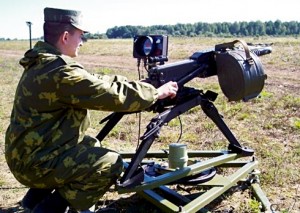 This is a Russian soldier with a Plamya automatic grenade launcher with Owl sights. The Owl triangulates on the sound of rifle fire and provides the gunner with an aiming point even if he cannot see you. It takes courage to shoot at him knowing of the hail of grenades you will get in return if you miss. People who are fat and happy and have the money to buy a Mark IV do not need a Mark IV. But desperate men and women with $400 tactical scopes on $600 deer rifles walk through the Plamya gunner’s nightmares.